How it ships into your coding-agent stack.
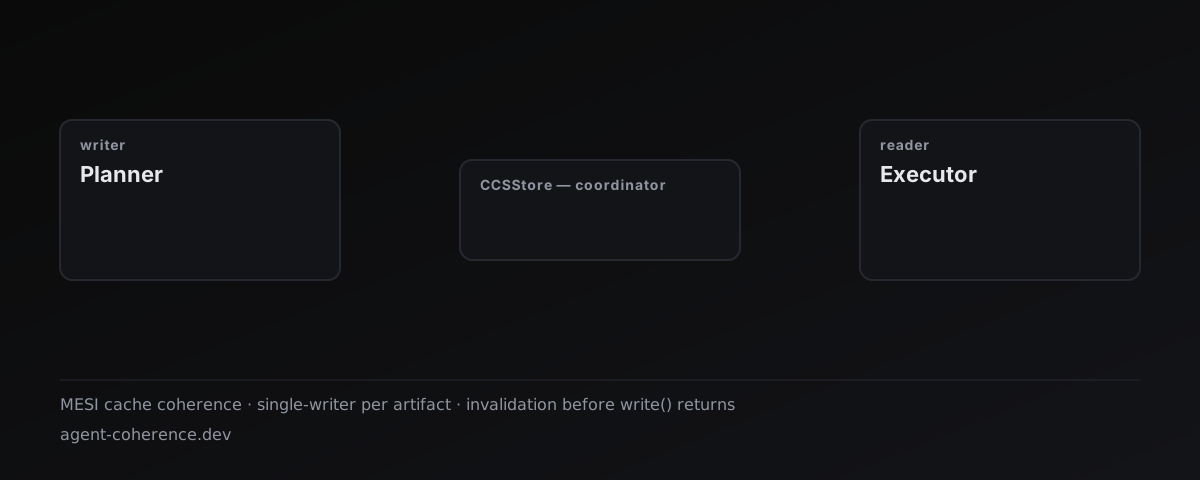
The task spec is just an artifact in CCSStore — a LangGraph BaseStore drop-in. Both sub-agents share the same store; the MESI protocol does the rest. No node-code changes.
# Coding-agent flow — planner and executor share a task spec via CCSStore
from langgraph.store.memory import InMemoryStore  # before
from ccs.adapters import CCSStore                  # after

store = CCSStore(strategy="lazy")
graph = builder.compile(store=store)

# Planner writes v2; CCSStore publishes invalidation to peers
# before write() returns. Executor's next get() is a fresh
# miss and pulls v2 — the stale cached copy is never served again.
The same protocol works on CrewAI and AutoGen via their adapters, and on custom orchestrators via CoherenceAdapterCore. Vendor-neutral across Anthropic, OpenAI, Google, Mistral, and open-source models — the protocol operates on artifacts, not model responses. Everything on this page is single-host: one coordinator, one machine. If your agents span hosts, that is an active co-design, not a shipped surface — open a GitHub Discussion or email us.
Two more surfaces shipped in v0.10.0. When a developer or a tool edits a managed shared file out of band — outside the coordinator — that foreign edit is caught the moment an agent writes over it (denied by default) or, opt-in, re-reads it, surfaced as StaleView and cleared with reacquire(). It covers files the volume manages; auto-watching unmanaged corpora is roadmap. And if your agents are MCP clients, stale-write-guard-fs (pip install "agent-coherence[mcp]") exposes the same coordinator over stdio — six tools (swg_read, swg_write, swg_reacquire, swg_write_cas, swg_gate, swg_status) — no orchestrator required. Sessions sharing one SWG_ROOT share one coordinator, so session B's stale write is denied even when session A made it stale, and two sessions racing the same file resolve through swg_write_cas: one wins, the loser gets a typed retryable conflict instead of a silent drop. It guards file access routed through the tools — it cannot see edits made around them.
Two adoption tiers.
Pick where on the commitment curve you want to start.
Hard
CCSStore — protocol-enforced coherence
Drop-in for LangGraph; adapters for CrewAI, AutoGen, custom orchestrators. A peer's write invalidates your cached view before write() returns, so the next read is a fresh miss — read-side coherence. put is not version-CAS: to deny a stale write-back outright, route writes through CoherentVolume or write_cas.
Advisory
ccs-diagnose — passive observation, zero code change
Passive diagnostic (pip install "agent-coherence[diagnose]") that runs your existing graph once under an observer callback and reports the artifacts whose reads can be handed stale versions. Detection only — it never blocks anything. Triage before commitment.
# zero-network, runs against your existing graph
ccs-diagnose --graph my_graph.py:build_graph
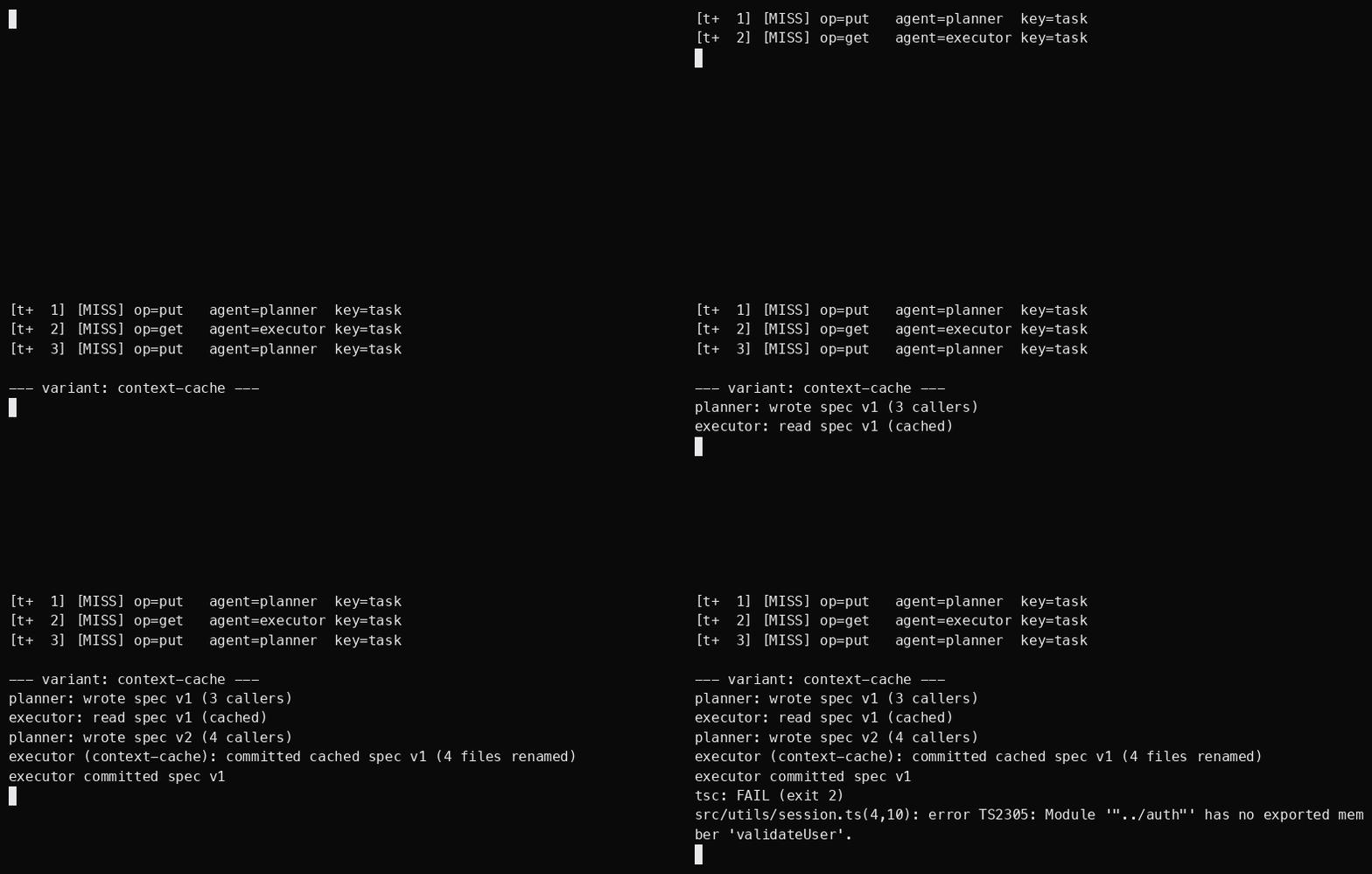
![Terminal recording: same as context-cache but the op log shows [HIT] on the commit-time executor get, proving the cache stayed SHARED at v1; same tsc FAIL outcome](/code/gifs/no-invalidation.gif)
![Terminal recording: planner writes v1, executor reads v1, planner writes v2, executor's next get is [MISS] and refetches v2, commits 5 files renamed, tsc OK](/code/gifs/with.gif)